
PRL Present · Launch presentation · UKBT Institute
The Townhouse: a guide to PRL
Built in SlideForge in the UKBT Institute theme · 38 slides · speaker notes included

← → navigate · N notes · F fullscreen · click the slide edges
Slide 1 · notes
Welcome. This is a guide, not a pitch: by the end the room should be able to take any innovation and say which floor of the Townhouse it is on, and what it needs to go up a level.
Your notes

Slide 2 · notes
Let this land. Technology readiness asks "can we build it?" Practitioner readiness asks "should we?" The PRL puts the second question first.
Your notes
Slide 3 · notes
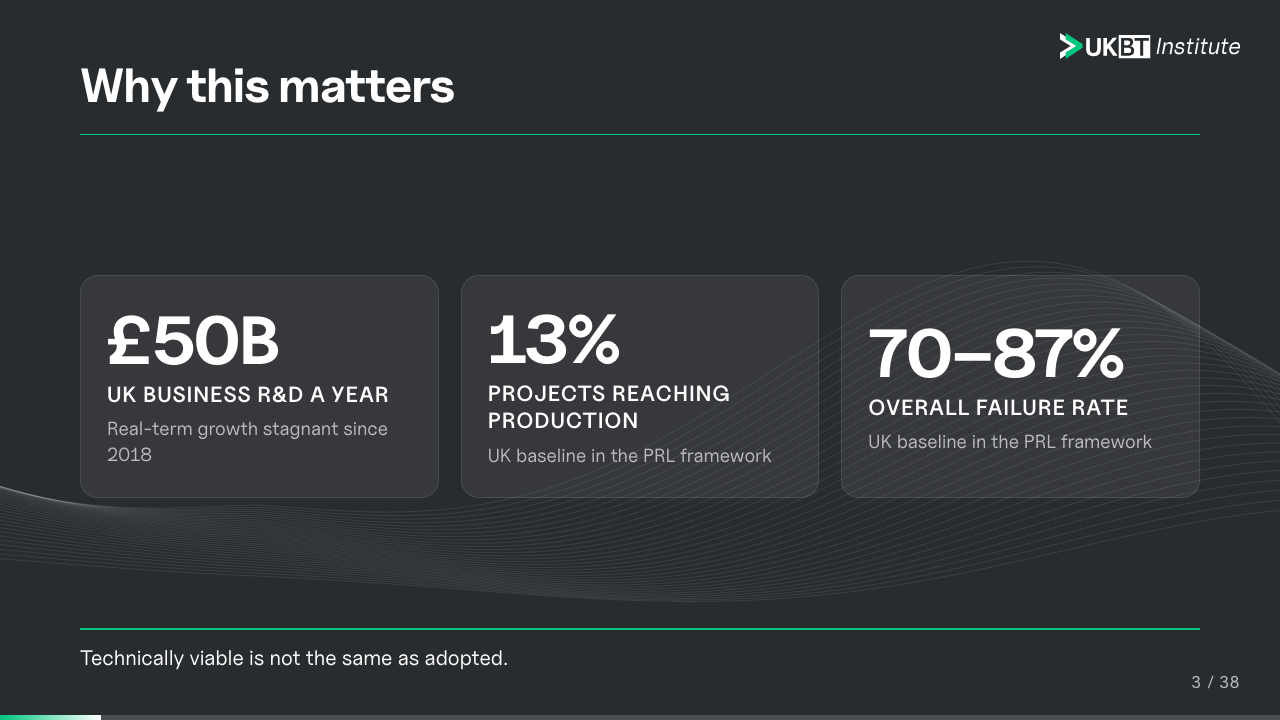
The £50B figure is from the Townhouse site copy; the two baselines are from the FORTRESS R&D PRL Framework v2.0. CONFIRM THE PRIMARY SOURCES BEFORE LAUNCH — a room of researchers will ask where 13% comes from, and the answer needs to be a citation, not "the framework".
Your notes
Slide 4 · notes
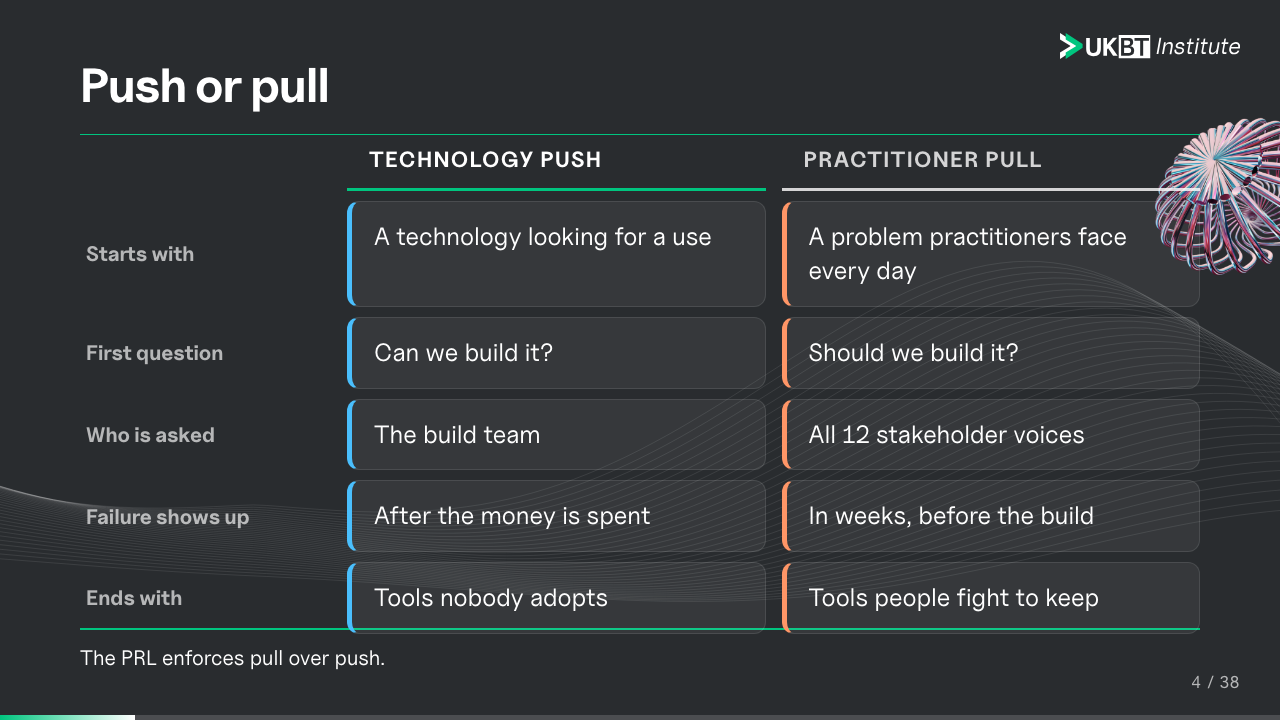
Read across each row. Ask the room which column their last project sat in.
Your notes
Slide 5 · notes
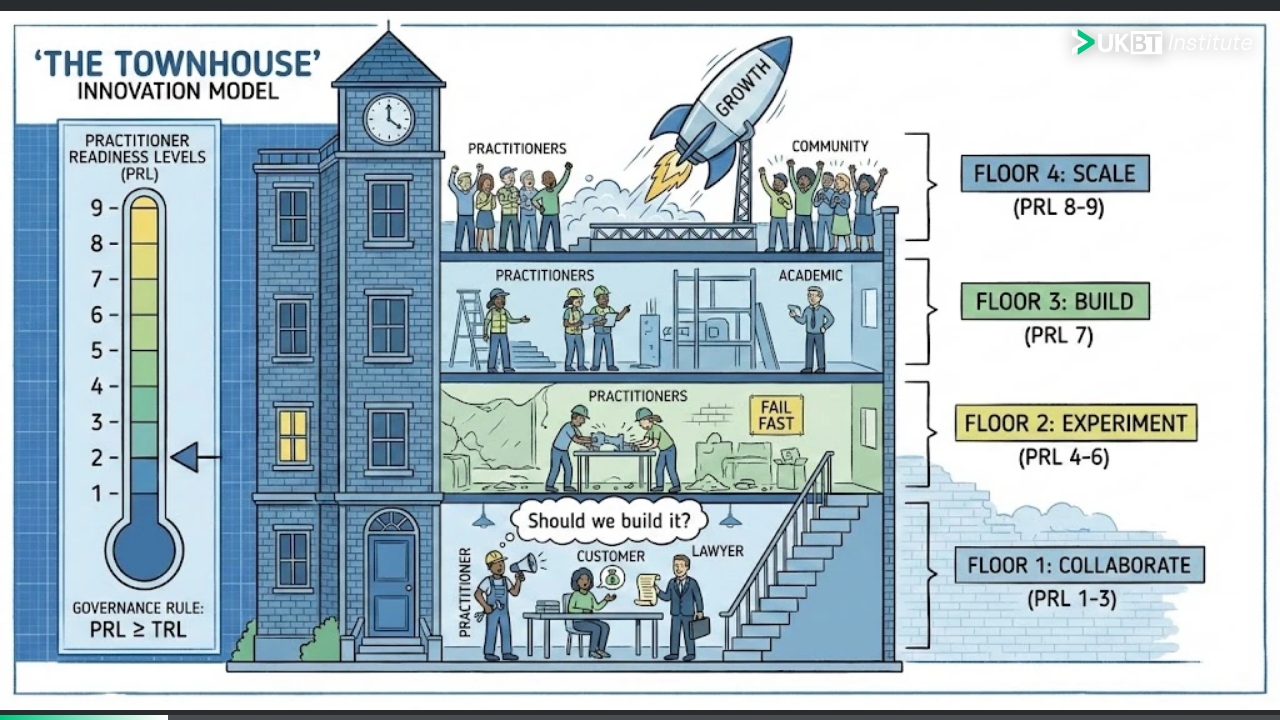
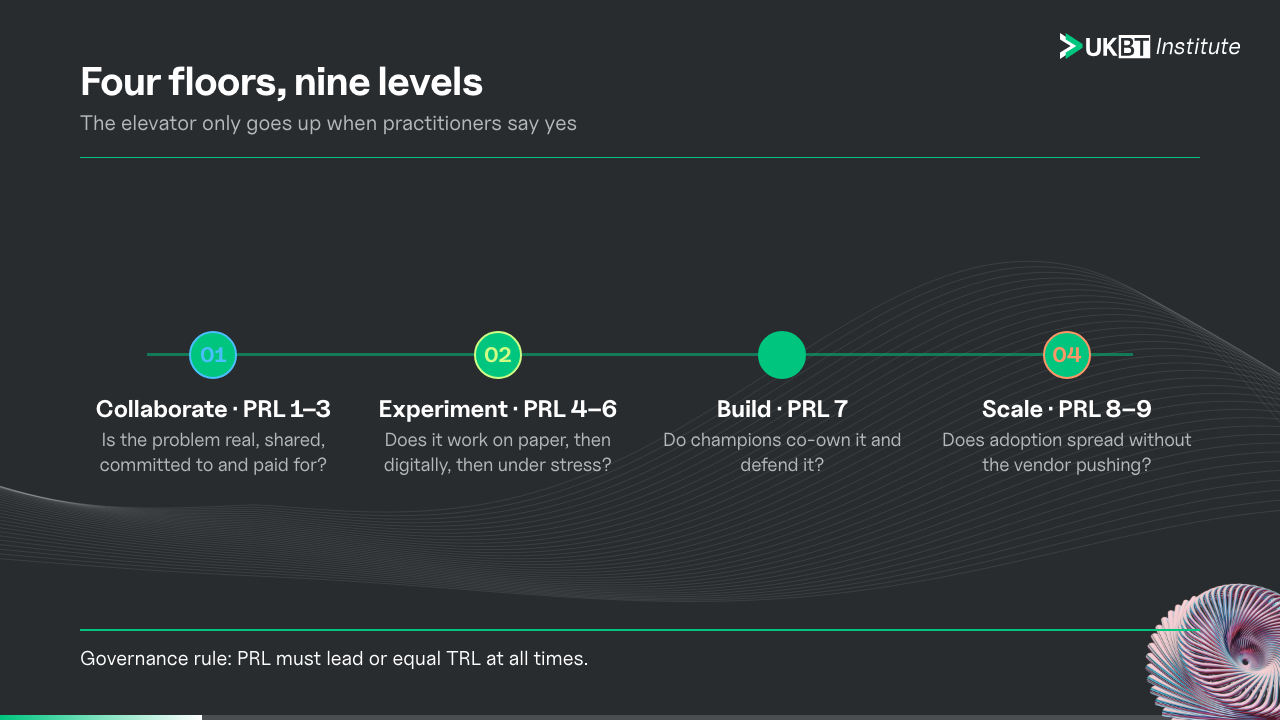
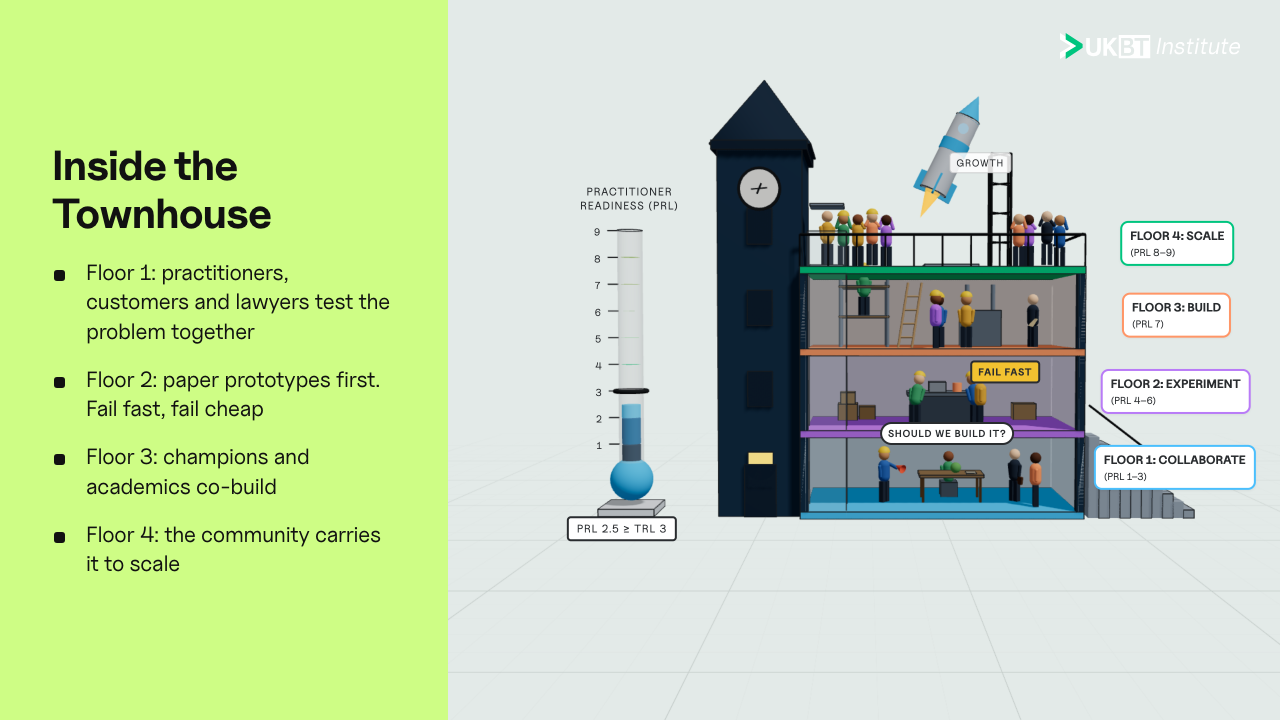
This is the whole model on one page. Walk it from the ground up: nothing moves up a floor until the people on that floor say yes. Four floors (Collaborate, Experiment, Build, Scale); the thermometer is practitioner readiness from 1 to 9; the governance rule is PRL ≥ TRL.
Your notes
Slide 6 · notes
These are the FORTRESS stages. PRL 2.5 sits inside Collaborate: pilot commitment has no TRL equivalent, which is part of the point.
Your notes
Slide 7 · notes
A still from the interactive 3D model. The thermometer on the left fills to an example case at PRL 2.5, with its TRL ring at 3 — parity holds.
Your notes
Slide 8 · notes
Your notes
Slide 9 · notes
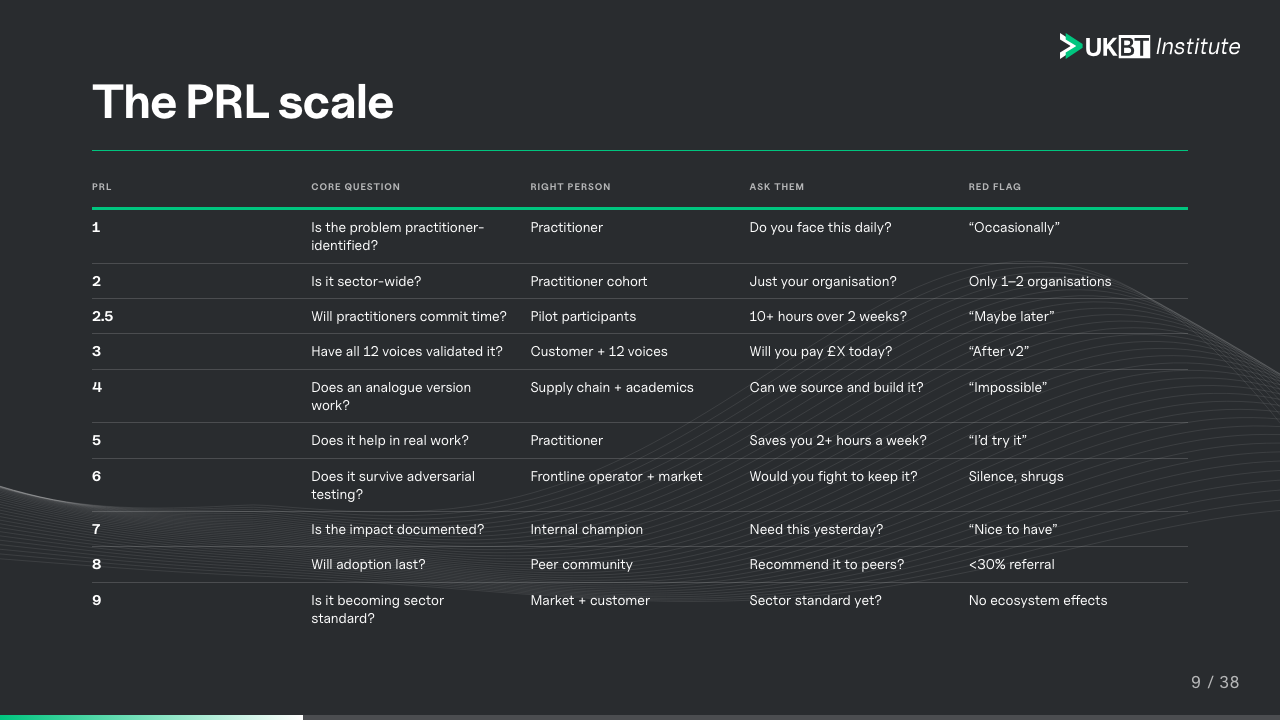
The whole scale. Every row has one question, one person who must answer it, and one answer that should stop you. The full wording of each level is in the framework document; this is the version to remember.
Your notes
Slide 10 · notes
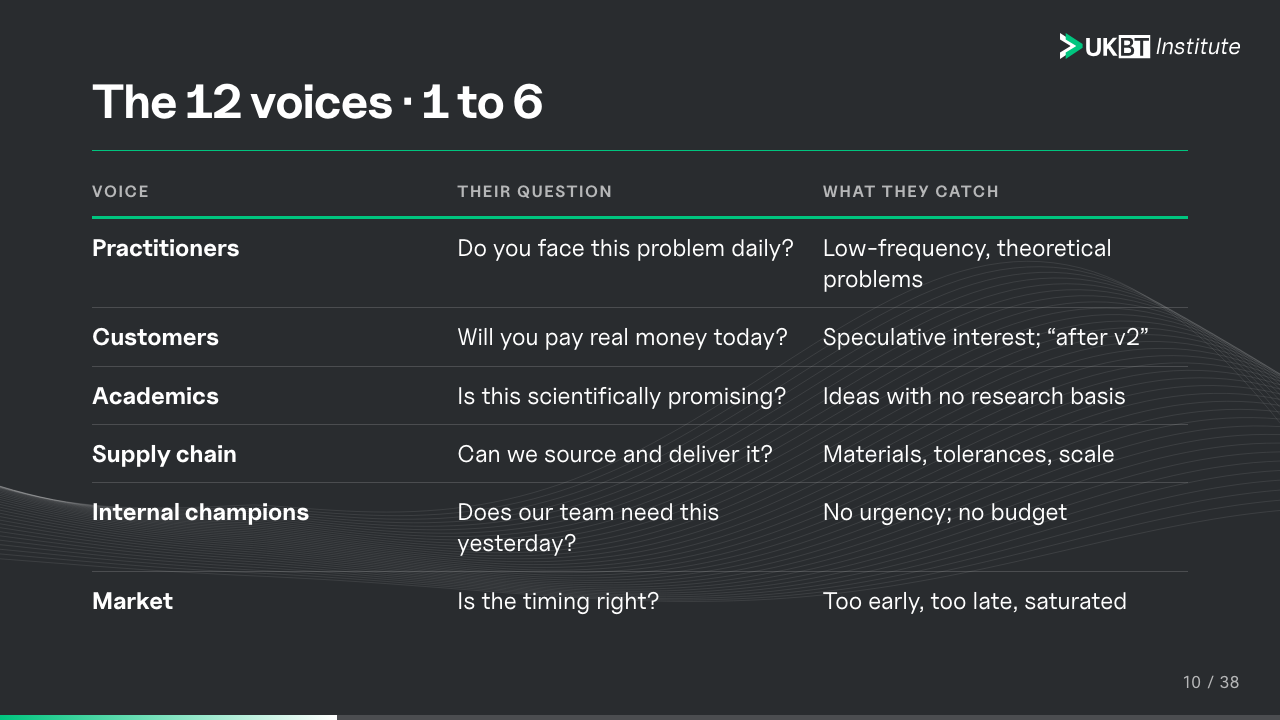
All twelve validate by PRL 3, no exceptions: eleven of twelve must say yes, and any red flag means pivot or kill. The list follows the published model at ukblacktech.com/ukbt-institute.
Your notes
Slide 11 · notes
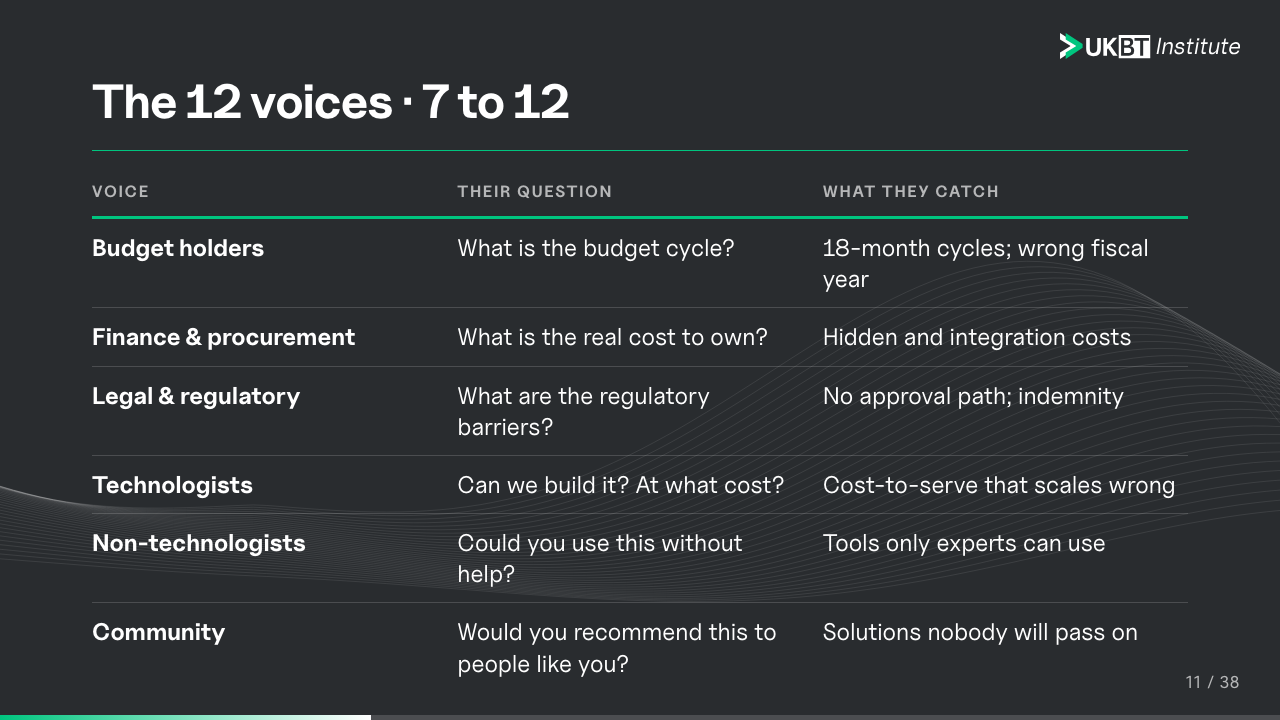
Point out how few of these voices are technical. CONFIRM THE LAST TWO ROWS: the published model names Non-technologists and Community but gives no question for them, so the wording here is ours.
Your notes
Slide 12 · notes
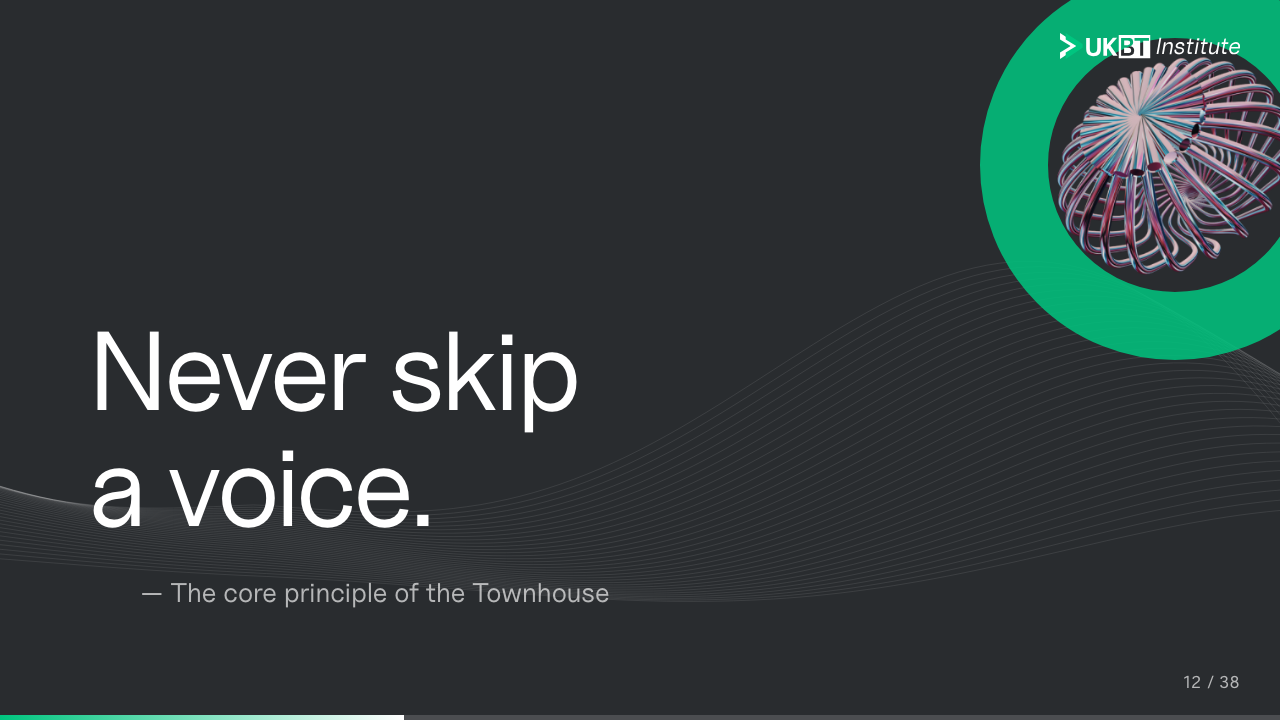
The single rule people should leave with. Skipping the lawyer or the budget holder is how a validated product dies in procurement.
Your notes
Slide 13 · notes
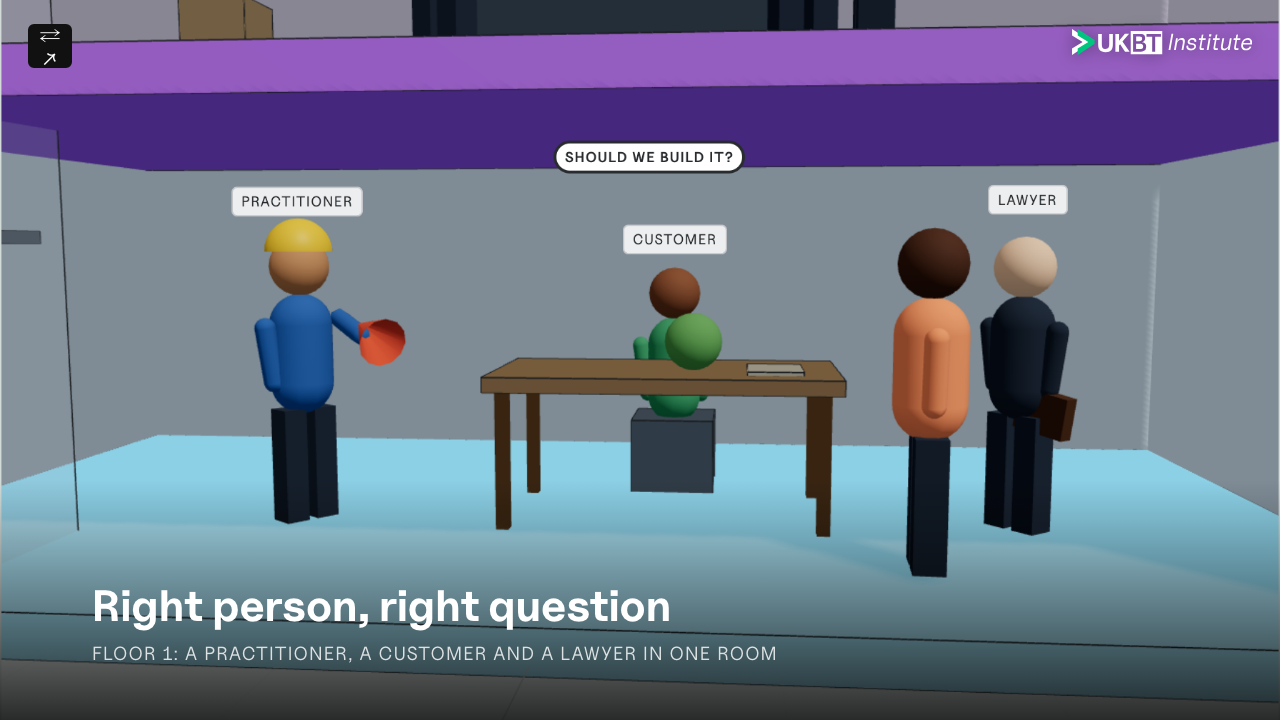
Flip for three real-world examples. The point: a red flag is a specific phrase you can learn to hear, not a feeling.
Your notes

Slide 14 · notes
Your notes
Slide 15 · notes
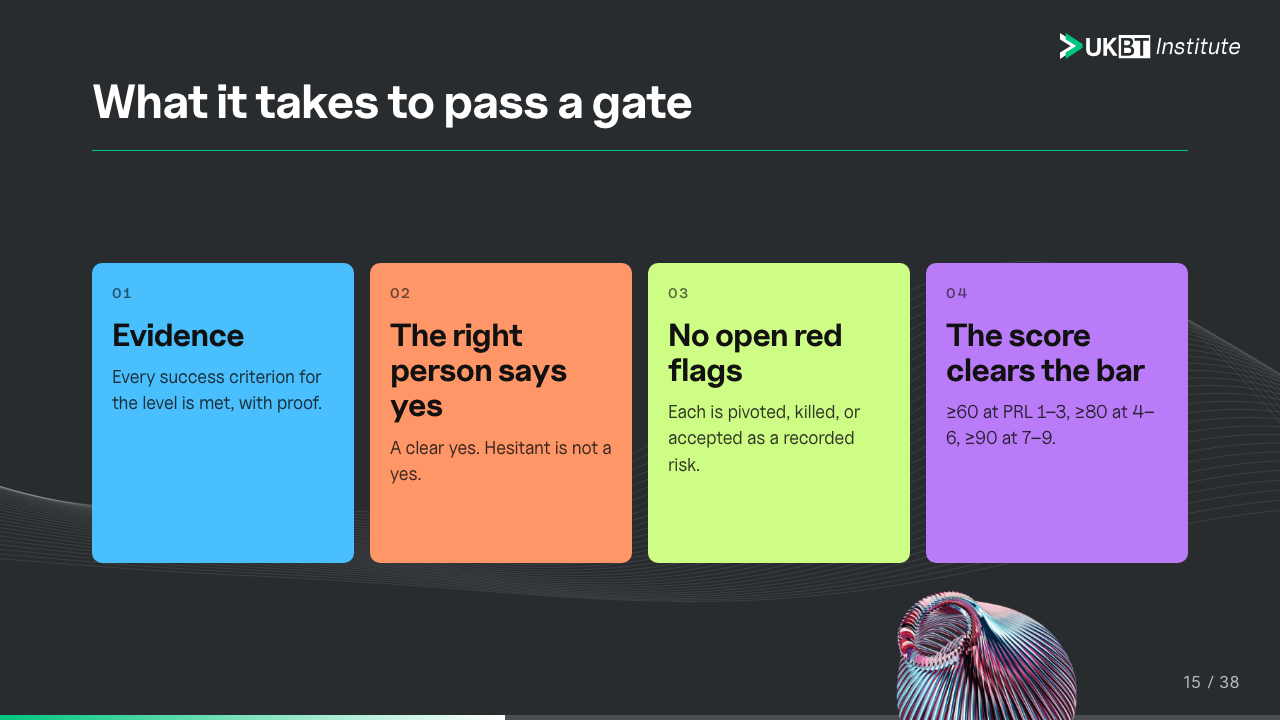
Four tests, all of them required. The fourth is the scoring matrix, coming up.
Your notes
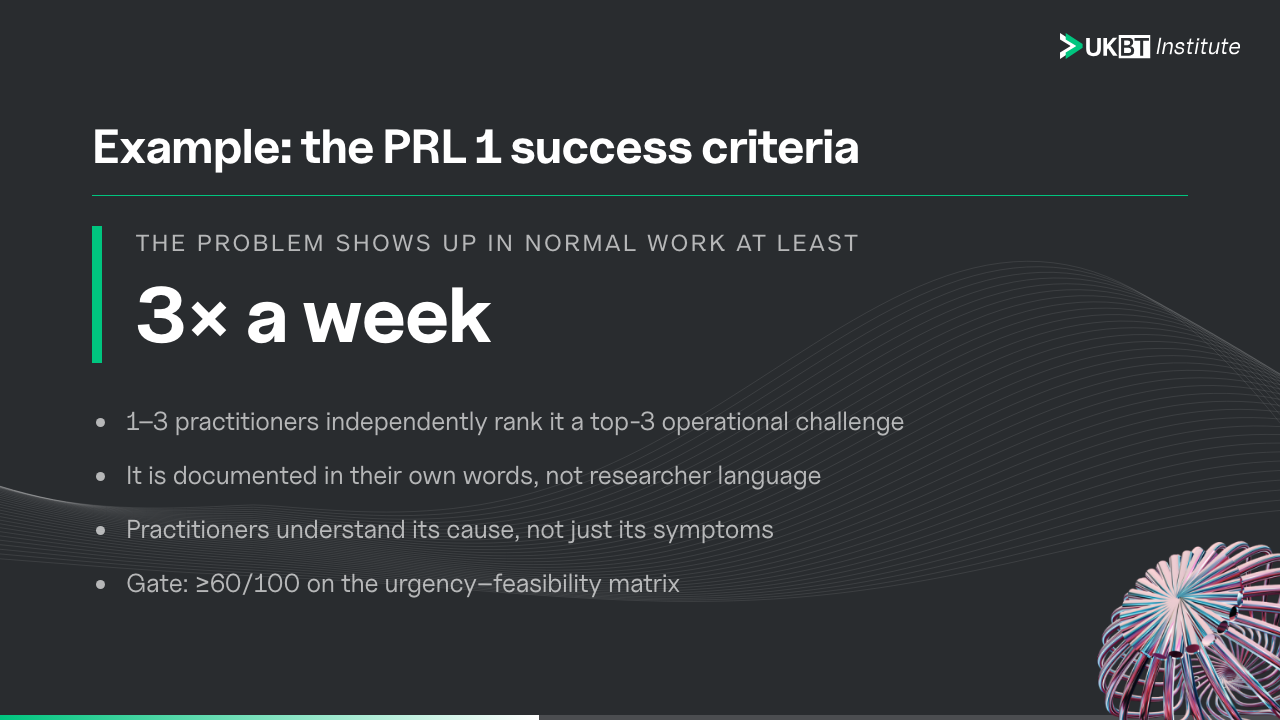
Slide 16 · notes
Every level has criteria this concrete. If a team cannot evidence these four, the problem is not ready, however good the technology.
Your notes

Slide 17 · notes
Your notes
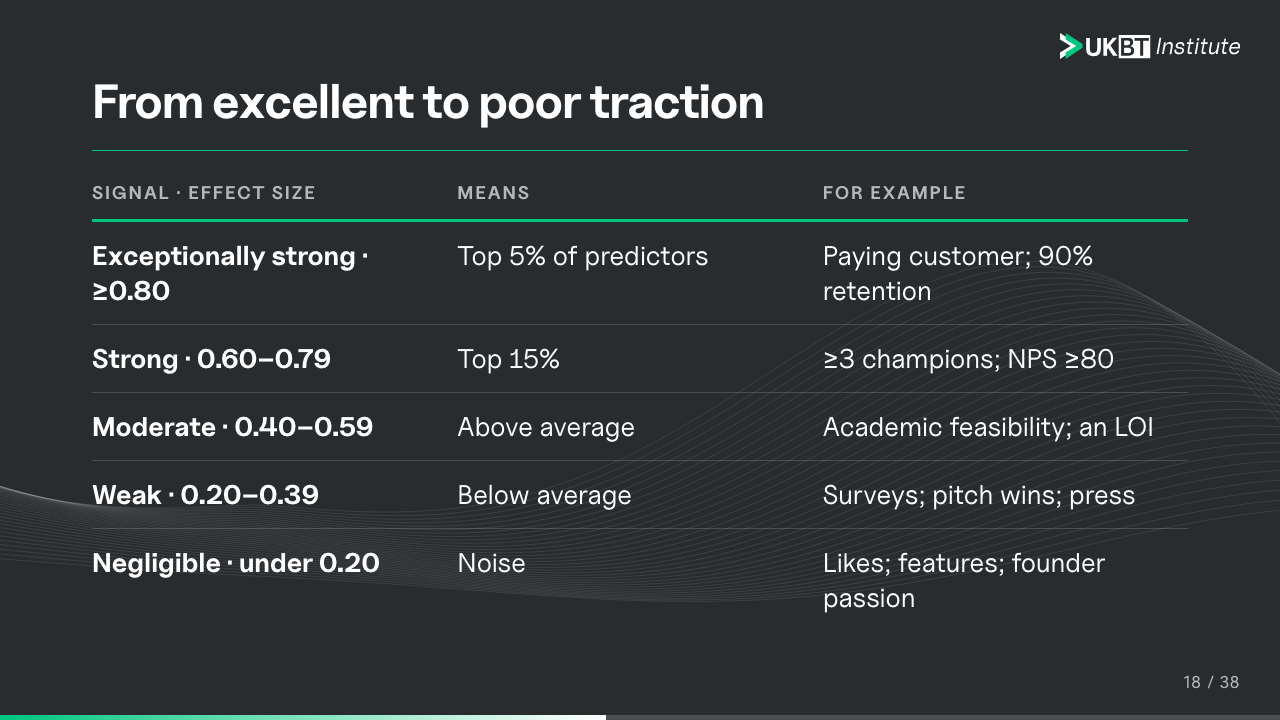
Slide 18 · notes
The interpretation guide. Every validation activity has an effect size: how strongly it predicts real adoption. This is the part of the model people remember — the things that feel like progress are mostly at the bottom.
Your notes
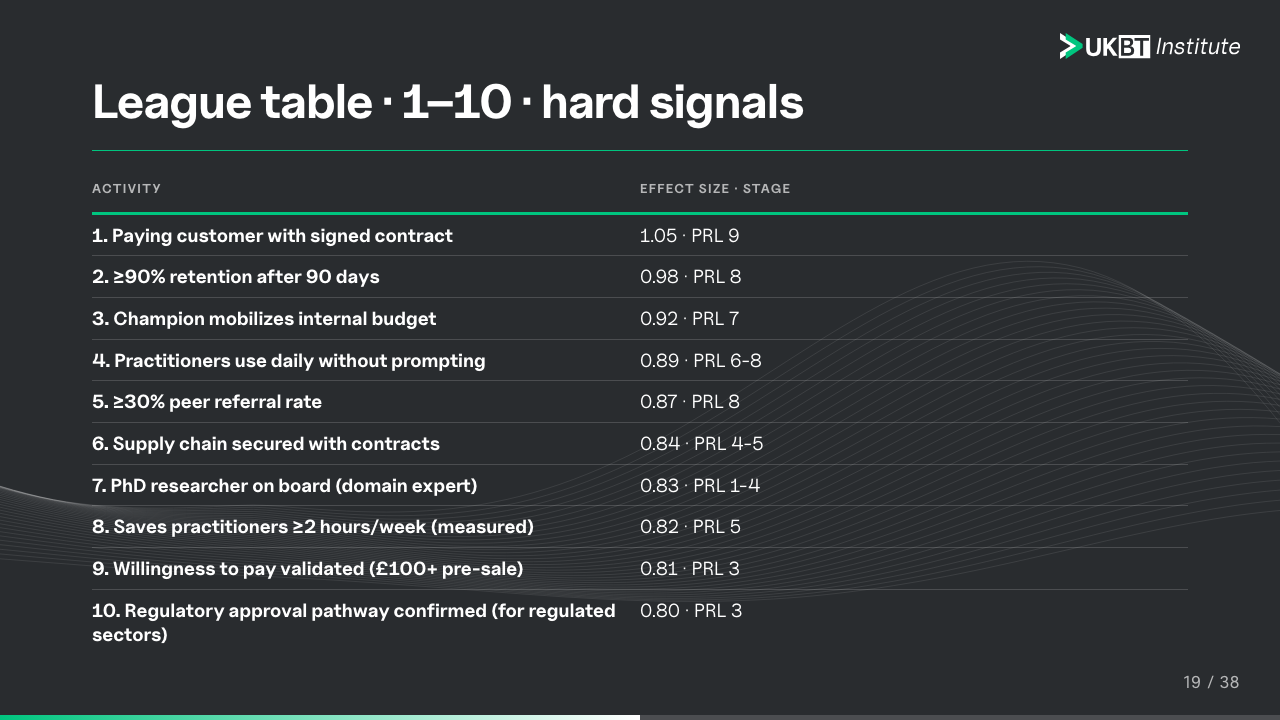
Slide 19 · notes
These ten are the "hard signals" the gates count. Money, retention, budget and daily use. UKBT Institute PRL framework: traction rankings. CONFIRM THE EVIDENCE CLAIMS before publishing: each score carries a source note (e.g. CB Insights) that a research audience will want to see. Stages: 1 PRL 9 · 2 PRL 8 · 3 PRL 7 · 4 PRL 6-8 · 5 PRL 8 · 6 PRL 4-5 · 7 PRL 1-4 · 8 PRL 5 · 9 PRL 3 · 10 PRL 3
Your notes
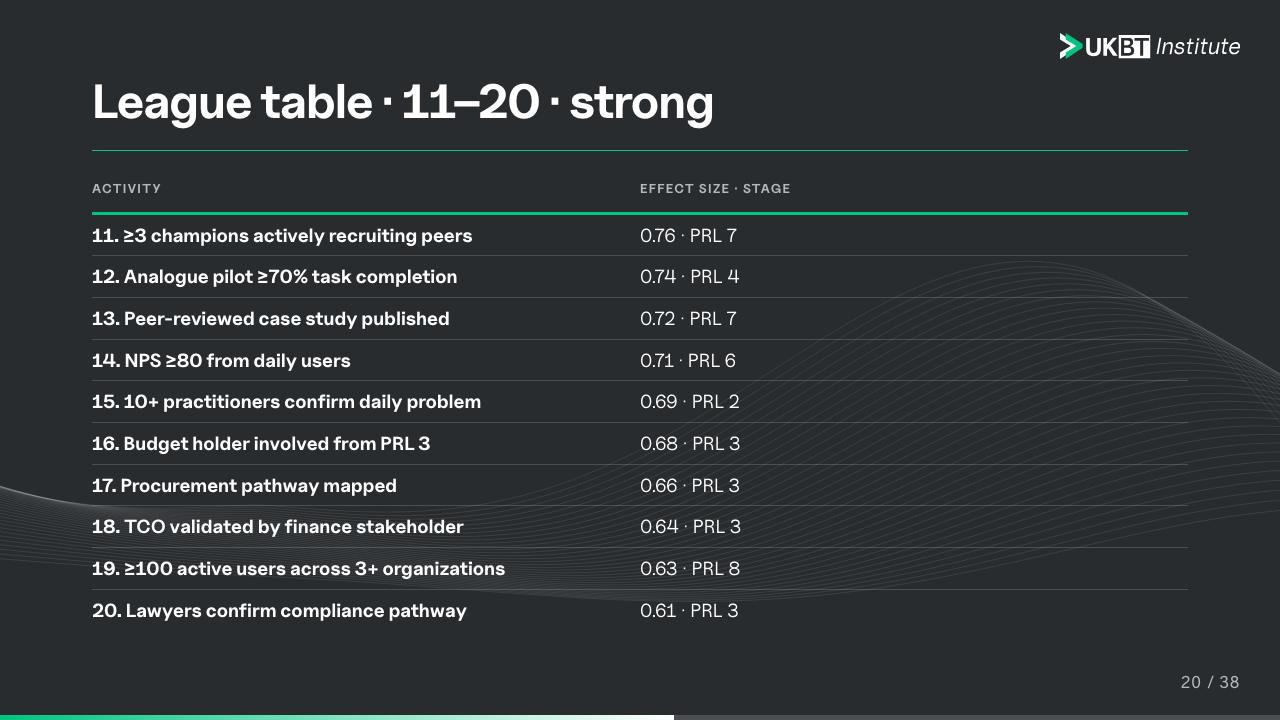
Slide 20 · notes
Strong, but not yet the proof a gate asks for. Champions recruiting, analogue pilots, NPS, a cohort confirming the problem. Stages: 11 PRL 7 · 12 PRL 4 · 13 PRL 7 · 14 PRL 6 · 15 PRL 2 · 16 PRL 3 · 17 PRL 3 · 18 PRL 3 · 19 PRL 8 · 20 PRL 3
Your notes
Slide 21 · notes
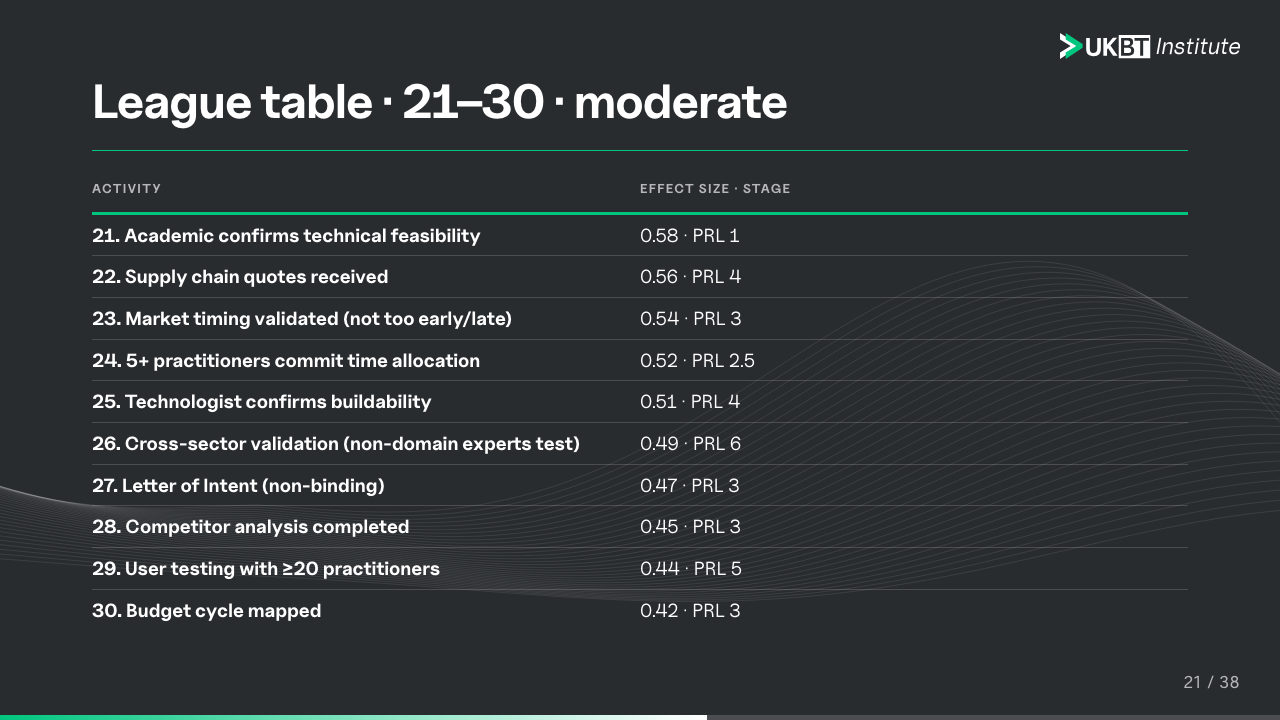
Useful groundwork. A letter of intent sits here, well below a £100 pre-sale. Stages: 21 PRL 1 · 22 PRL 4 · 23 PRL 3 · 24 PRL 2.5 · 25 PRL 4 · 26 PRL 6 · 27 PRL 3 · 28 PRL 3 · 29 PRL 5 · 30 PRL 3
Your notes
Slide 22 · notes
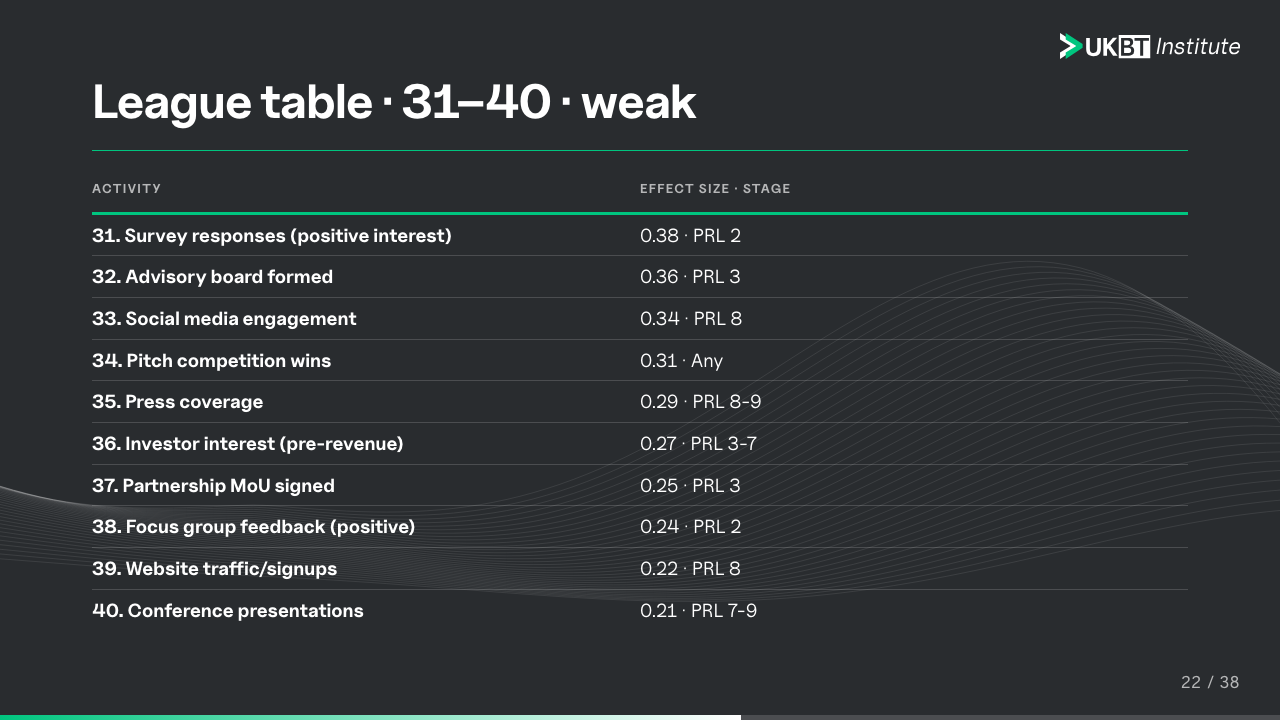
The bottom of the table: surveys, advisory boards, likes, pitch competitions, press, investor interest before revenue, and founder confidence at 0.04. None of it is bad — it just is not evidence. Stages: 31 PRL 2 · 32 PRL 3 · 33 PRL 8 · 34 Any · 35 PRL 8-9 · 36 PRL 3-7 · 37 PRL 3 · 38 PRL 2 · 39 PRL 8 · 40 PRL 7-9
Your notes
Slide 23 · notes
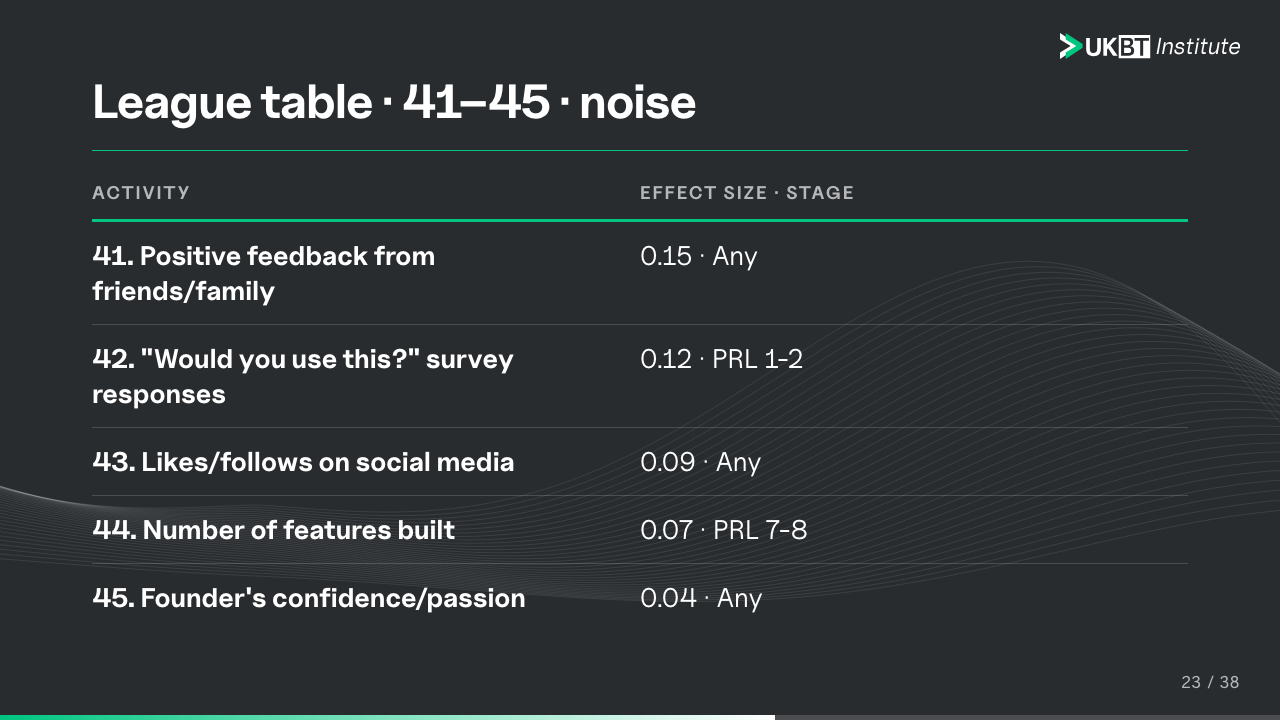
The noise: friends and family, the would-you-use-this survey, likes, features built — and founder confidence, at 0.04, the least predictive thing on the list. Stages: 41 Any · 42 PRL 1-2 · 43 Any · 44 PRL 7-8 · 45 Any
Your notes
Slide 24 · notes
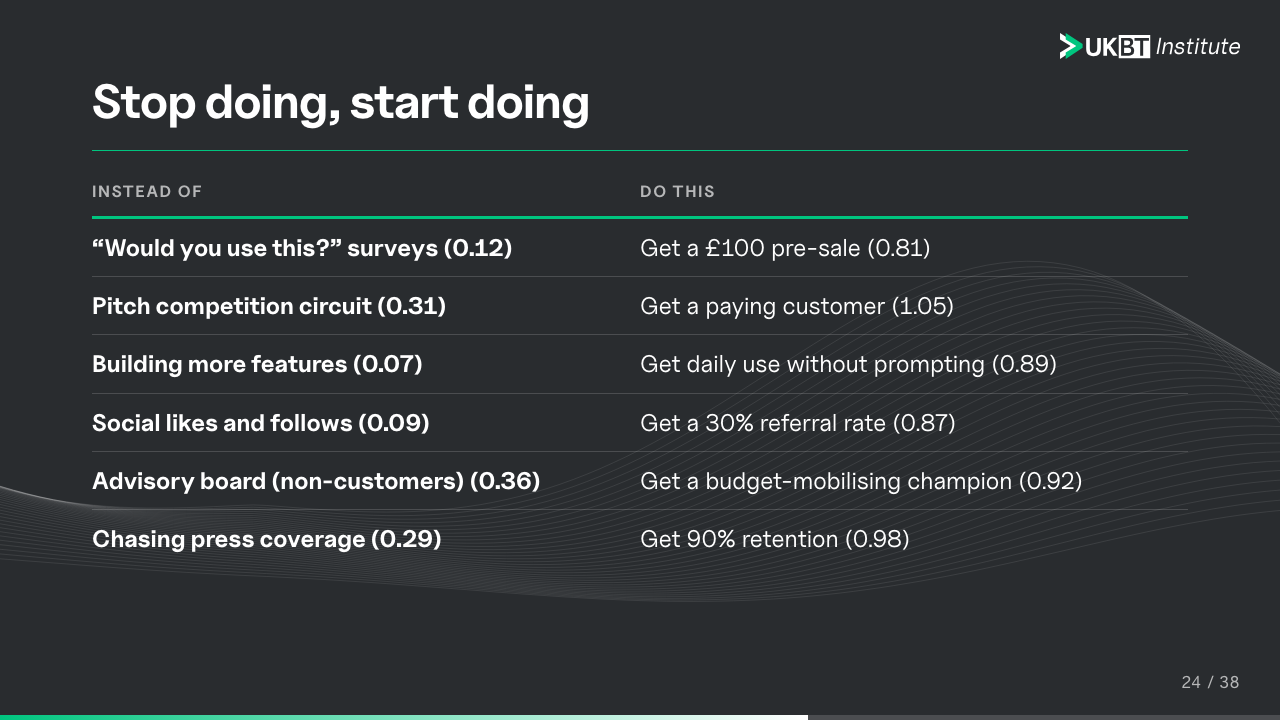
Each row is a trade: the activity founders reach for because it feels like progress, and the hard signal to chase instead.
Your notes
Slide 25 · notes
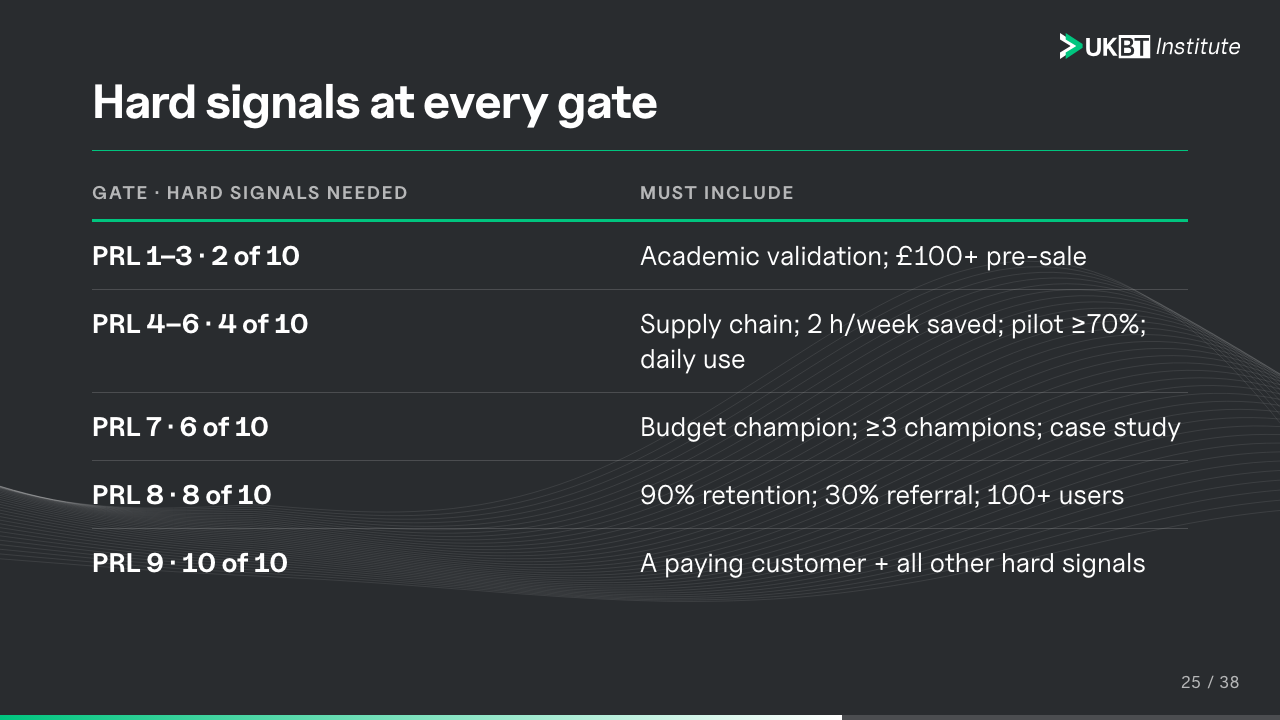
The rule that ties the league table to the gates. PRESS — the sum of effect size × achievement — gives a single traction score: under 2 is insufficient, 8+ is exceptional. Decide on evidence: proceed with the hard signals met and no red flags; pivot at 50–75% of them; kill below half, or when the case rests on signals under 0.30.
Your notes
Slide 26 · notes
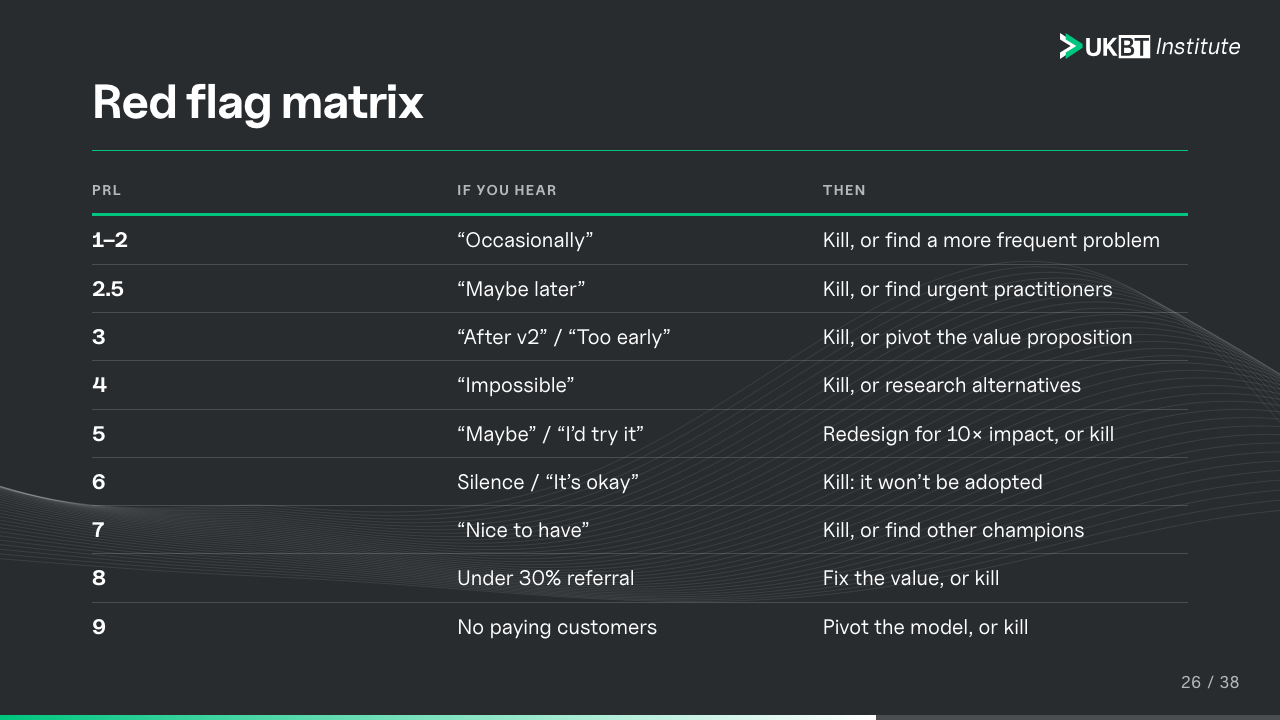
Rule: any red flag at its level is an automatic gate failure. "Kill" is not failure — a £10K kill fee in week three is the framework working.
Your notes
Slide 27 · notes
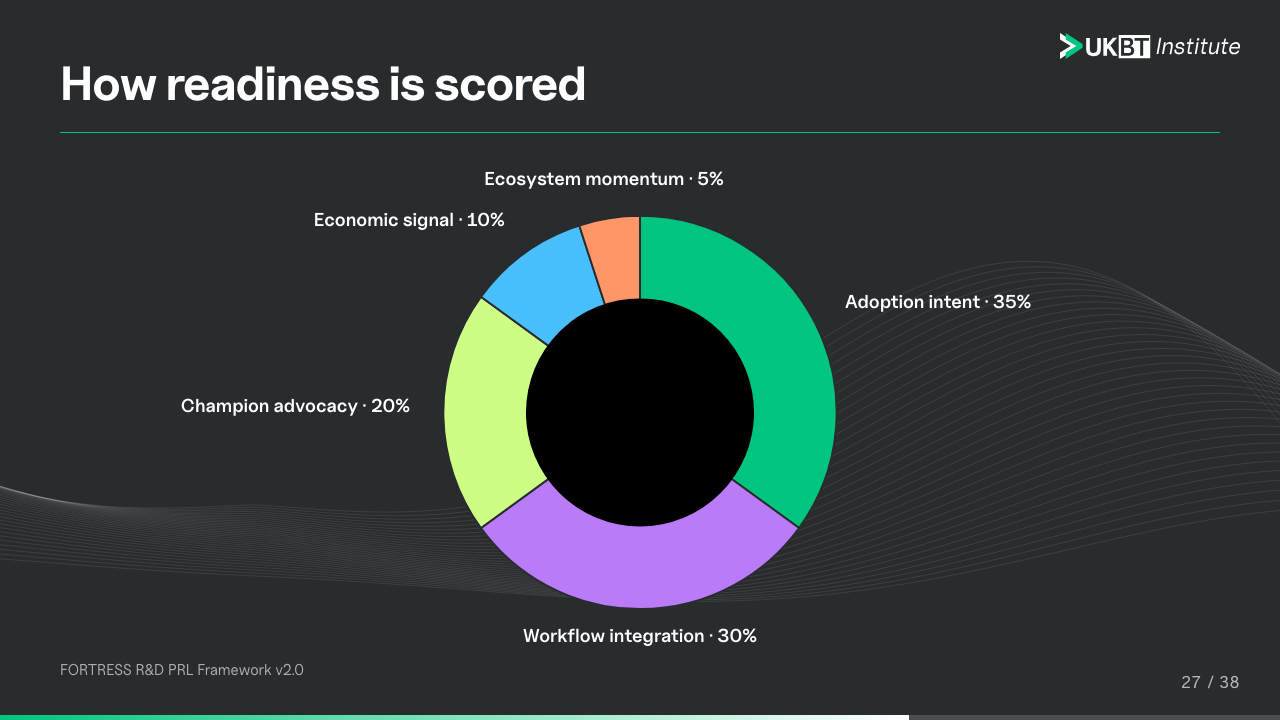
Adoption and workflow together are 65%: the model rewards use, not interest. Five weighted dimensions, scored 0–100 each, combined into one PRL score out of 100.
Your notes
Slide 28 · notes
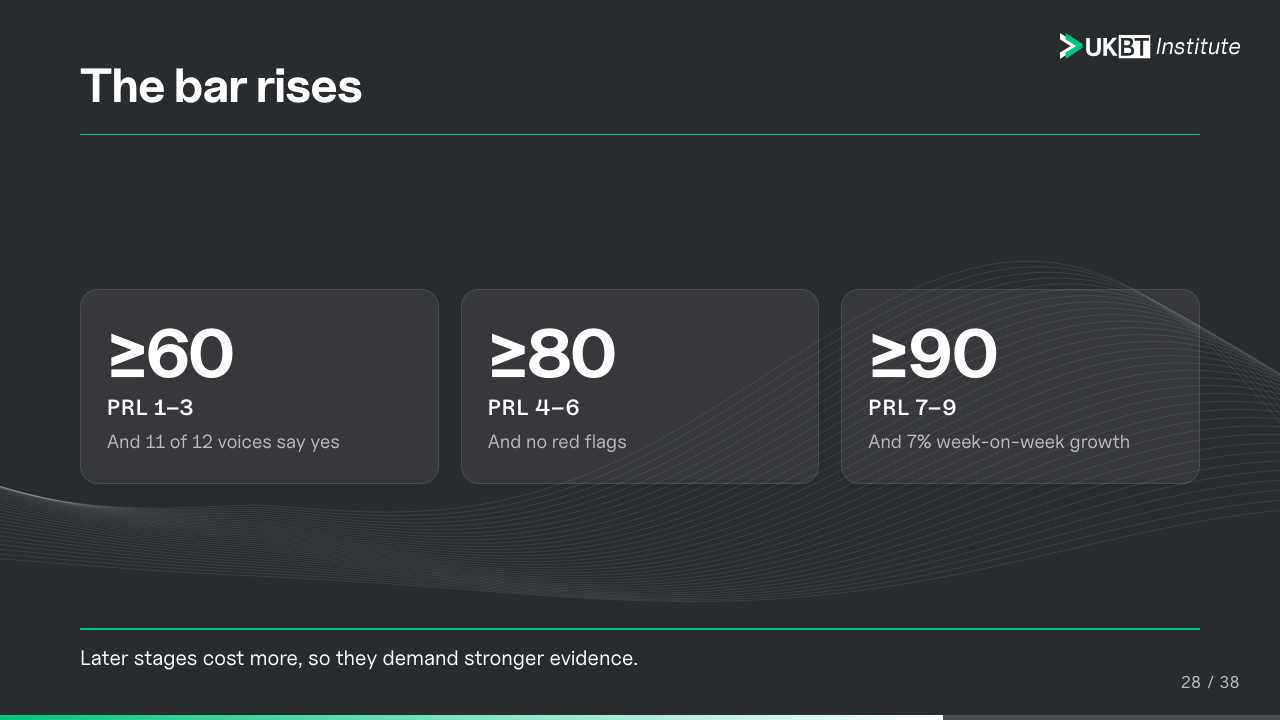
Gate pass requirements from the scoring matrix.
Your notes
Slide 29 · notes
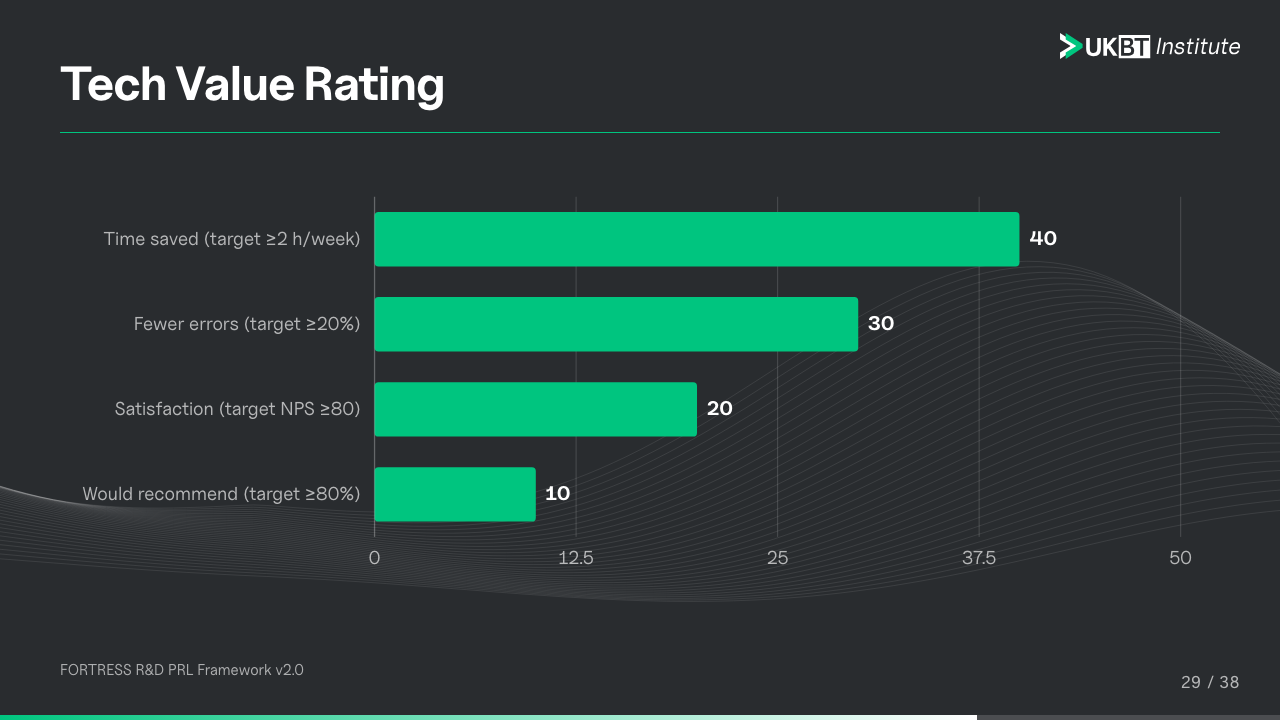
Each component scores 10 when it exactly meets its target, so TVR 10 means "targets met on average". A worked example: 3 h/week, 25% fewer errors, NPS 82 and 85% recommend gives 12.9.
Your notes

Slide 30 · notes
Your notes
Slide 31 · notes
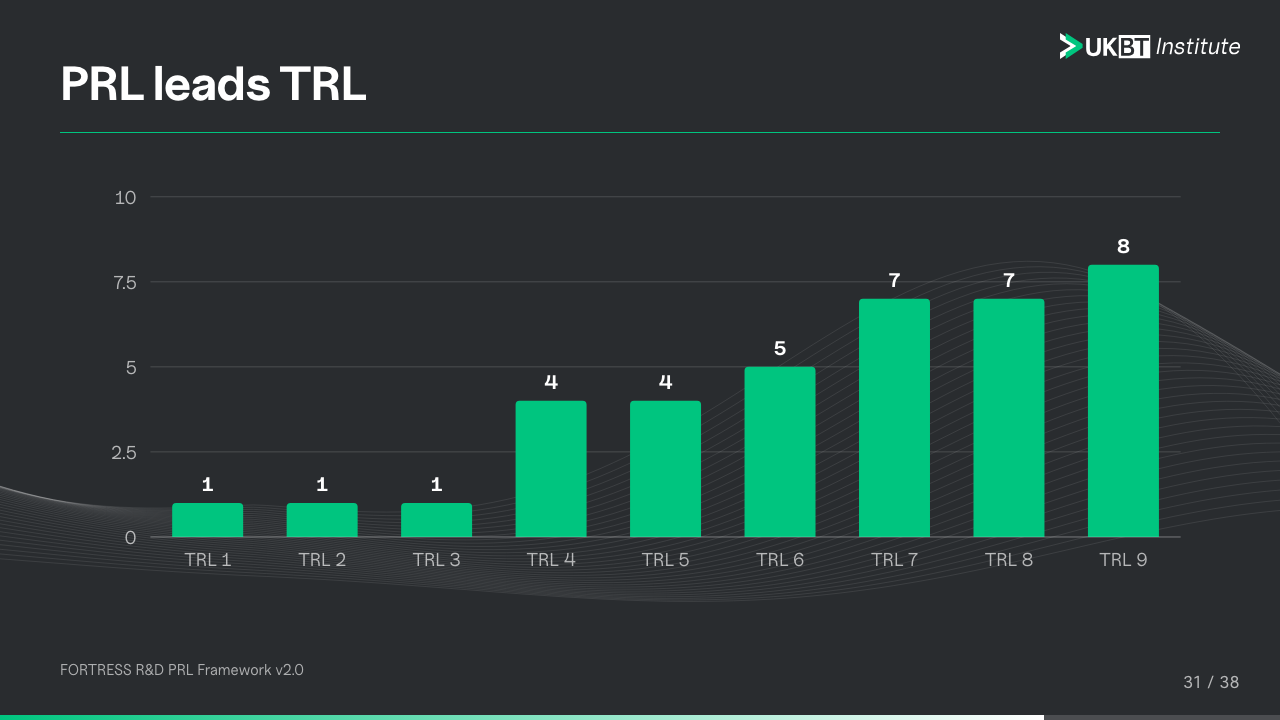
The staircase. Technology may only climb as far as practitioners have validated. TRL 6 is the one hard gate with no exceptions.
Your notes
Slide 32 · notes
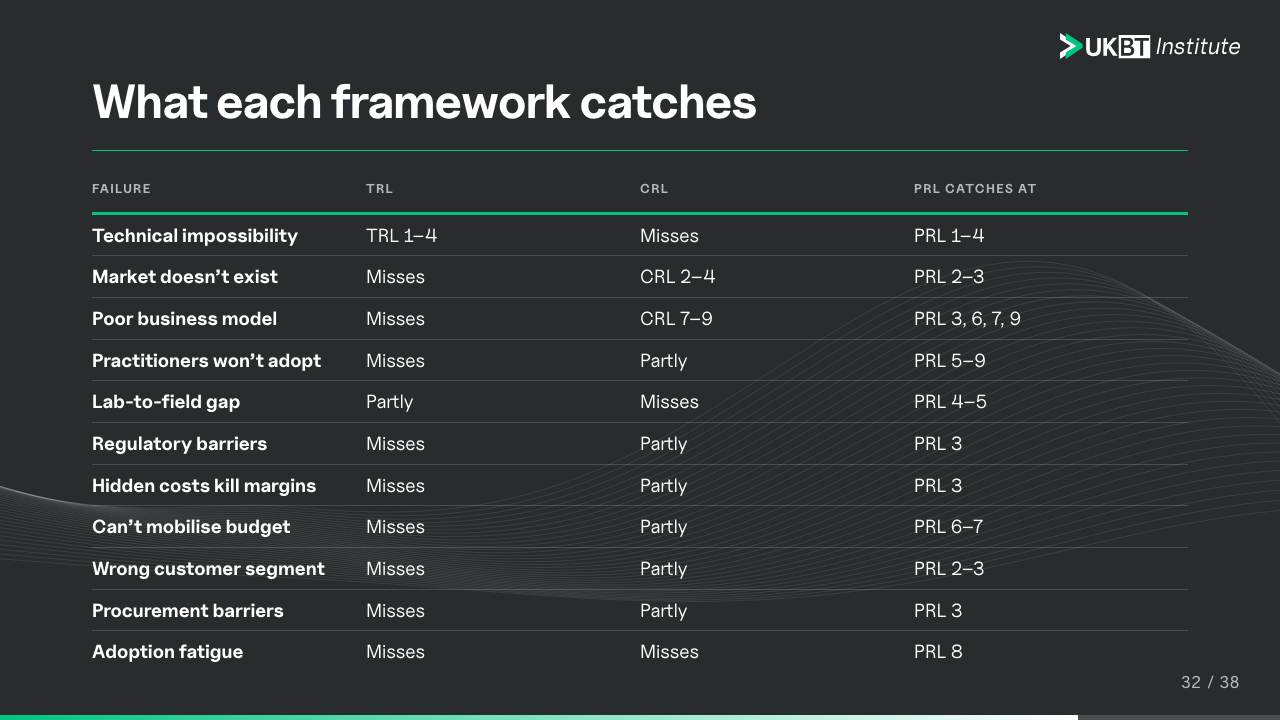
Eleven of the framework's thirteen failure types. TRL and CRL each catch a few, late; the Townhouse catches all of them, in parallel, because every voice is in the room at once.
Your notes
Slide 33 · notes
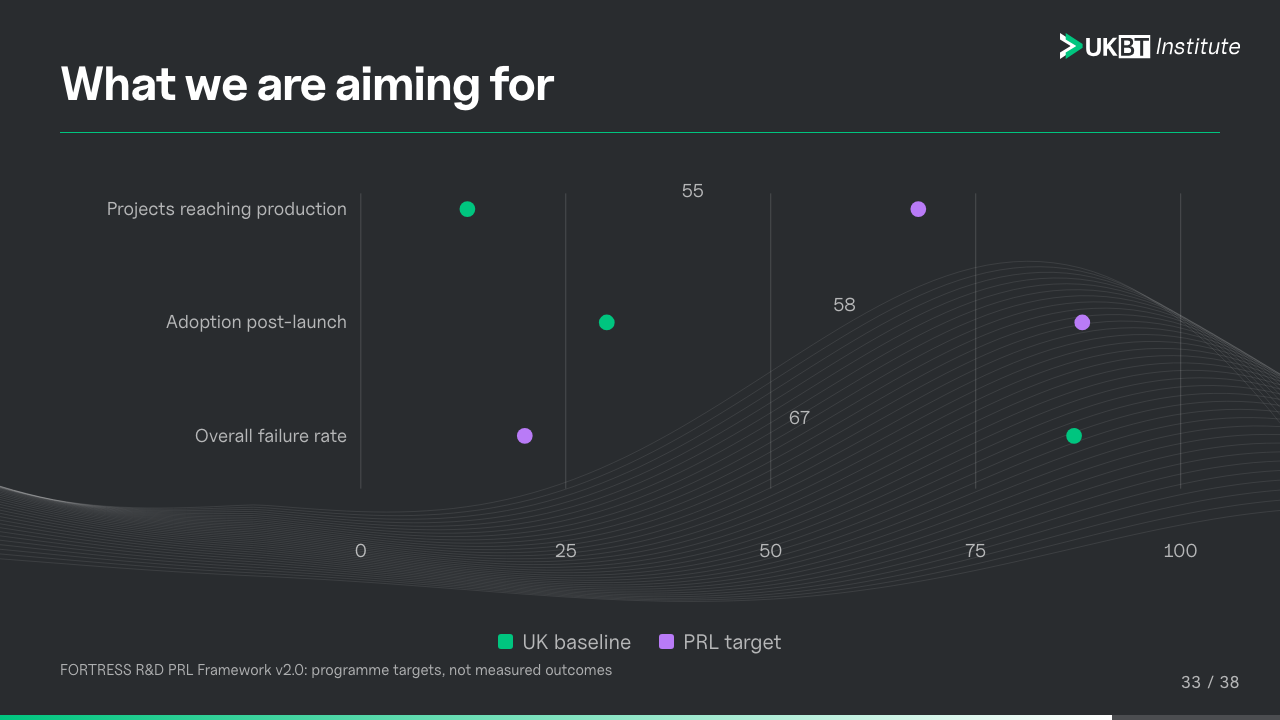
THESE ARE TARGETS. Say so out loud. Nothing on this slide has been measured yet; the Townhouse is launching, and the first cohort is how we find out. Presenting targets as results is the fastest way to lose a research audience.
Your notes
Slide 34 · notes
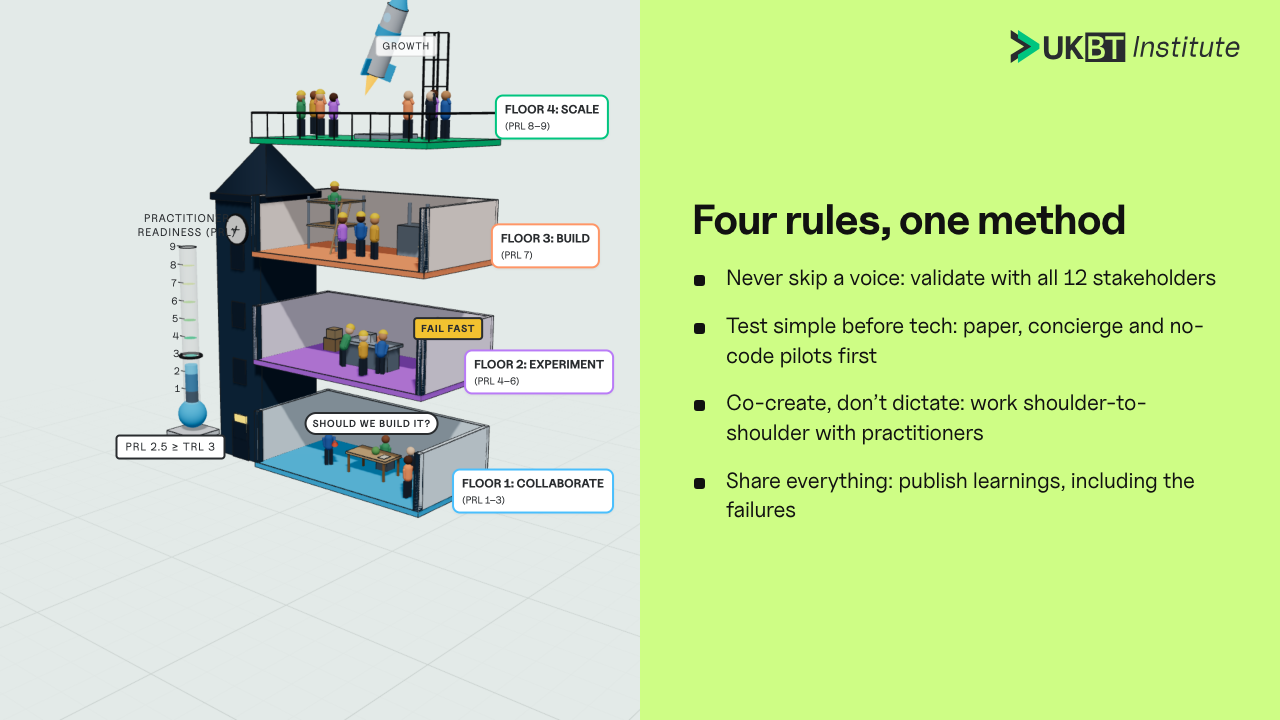
The exploded model: each floor is a stage, and each stage lives by one rule.
Your notes

Slide 35 · notes
Open the room first (the join slide or the Live button). Expect most of the room in the first two options — that is the Townhouse's natural audience.
Your notes
Slide 36 · notes
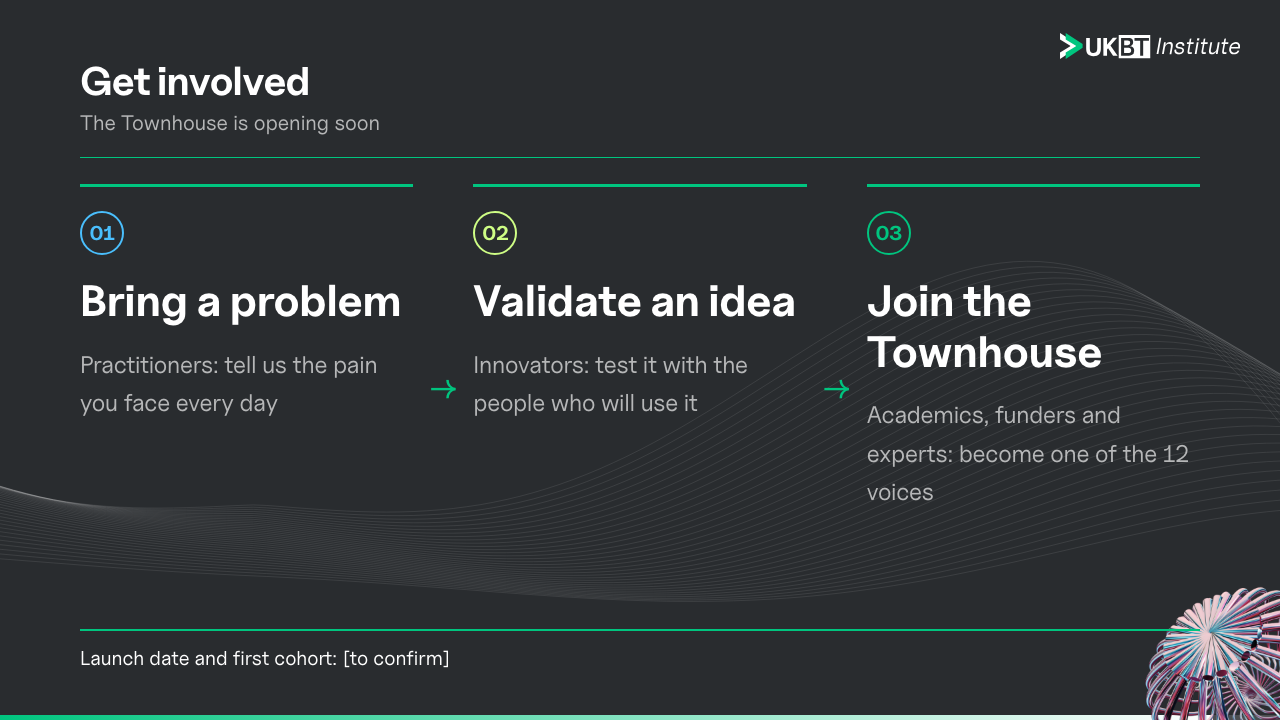
FILL IN THE LAUNCH DATE AND HOW TO APPLY before this deck goes out. A call to action without a date or a contact is not one.
Your notes

Slide 37 · notes
Add the Townhouse application link here once it exists.
Your notes
Slide 38 · notes
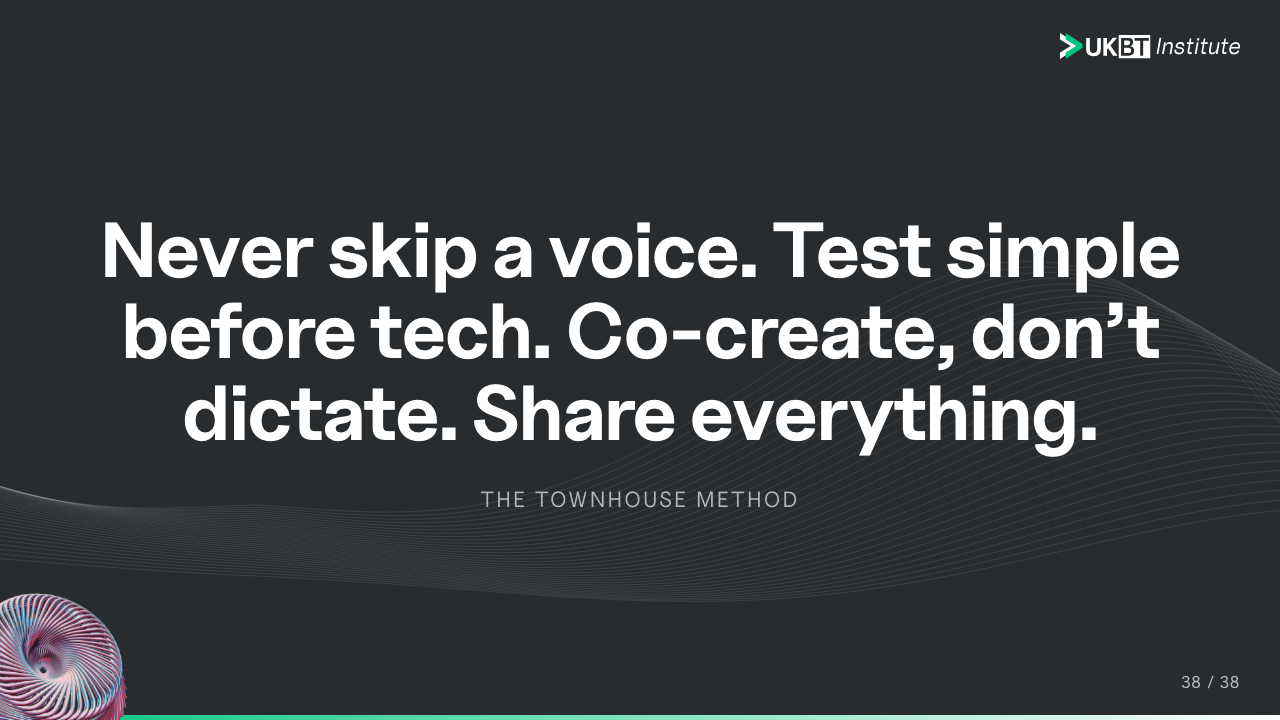
Close on the four rules and let the room answer. The word cloud is a genuine input for the first cohort — keep the export.
Your notes